4D-EEKG: A Four-Tier Spatio-Temporal Episodic-Entity Knowledge Graph Architecture with Signed Associative Plasticity and Emergent Continuous Taxonomic Manifolds
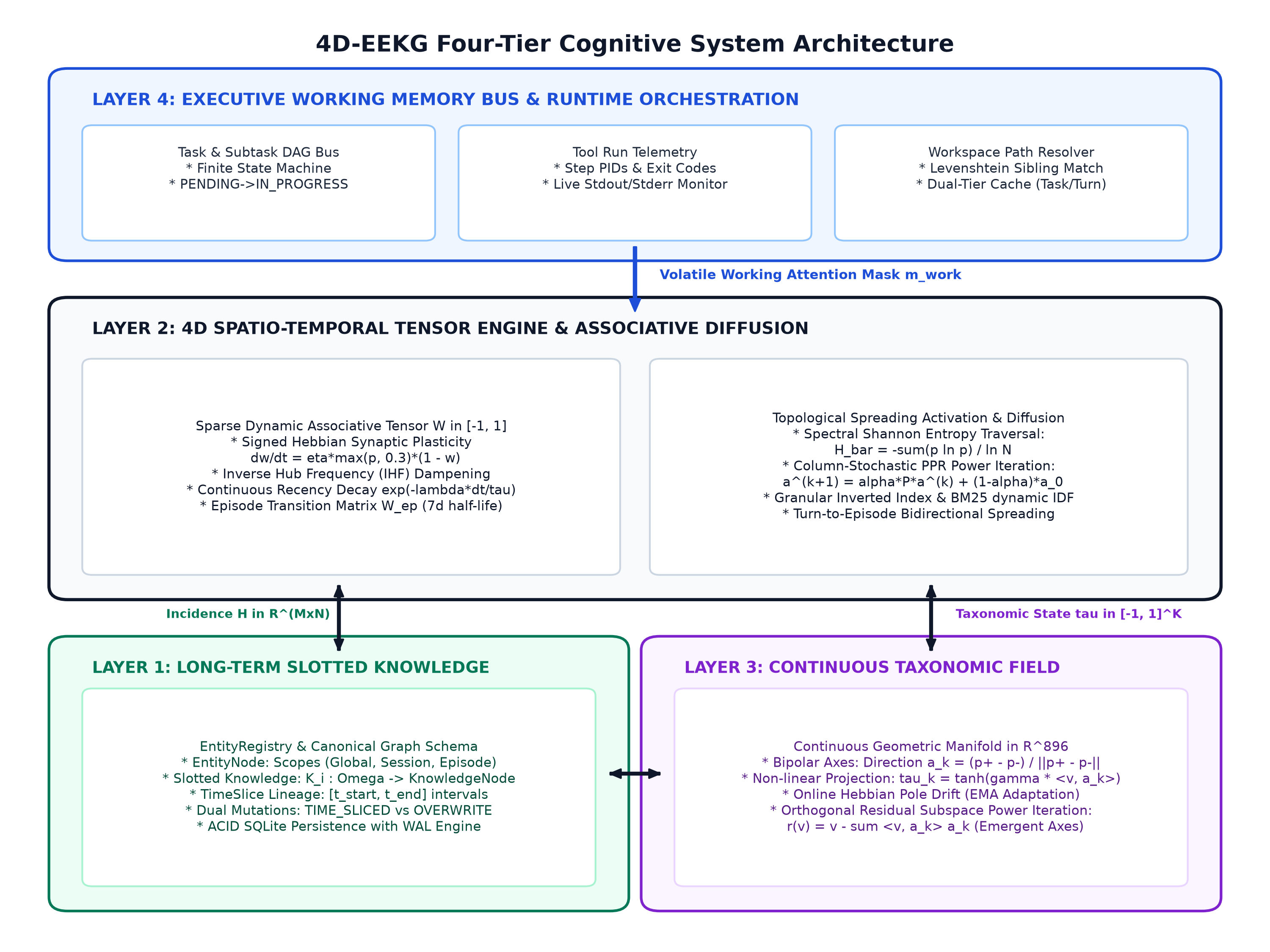
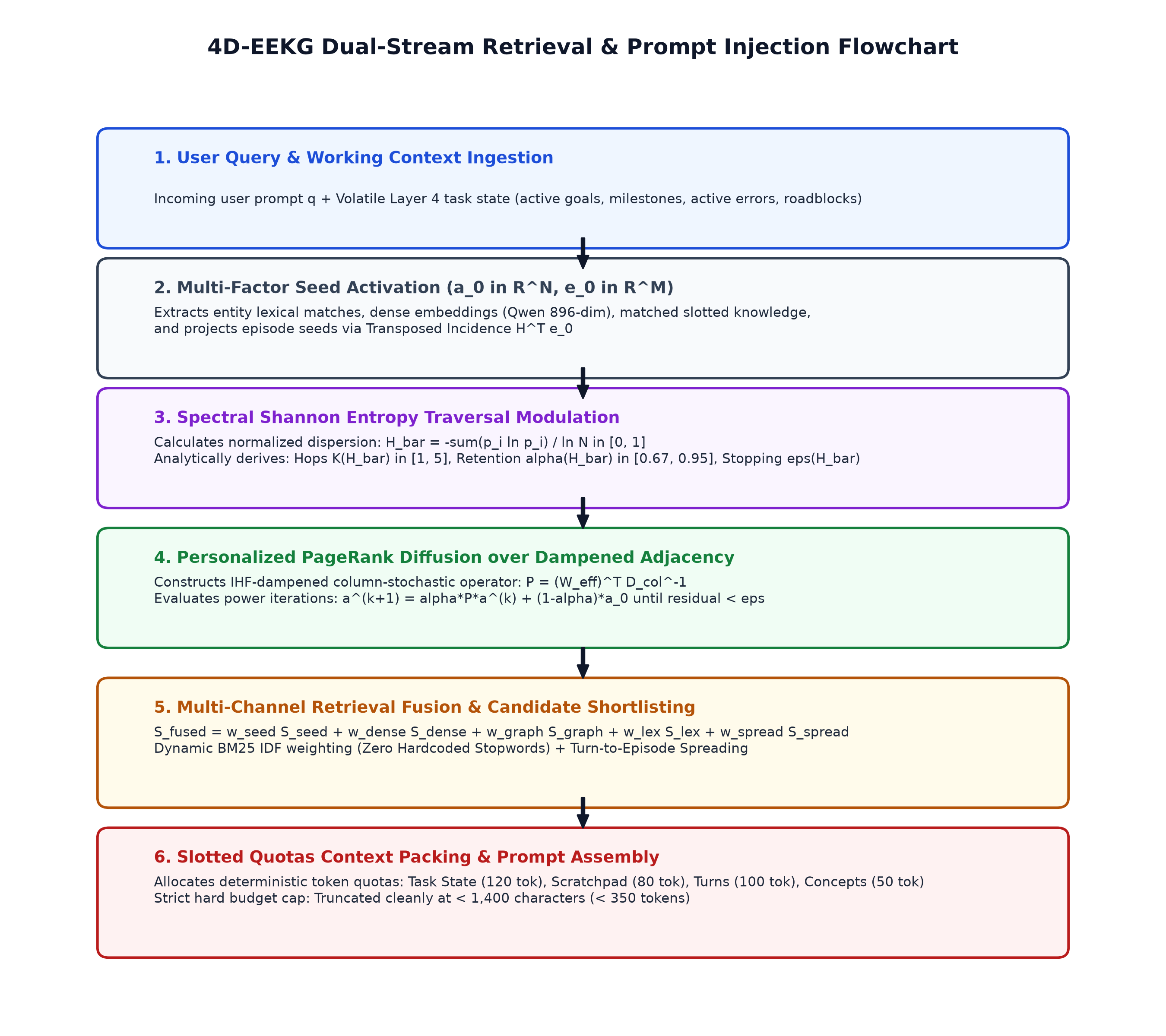
Technical Specification & Systems Foundations Report (November 2026)Autonomous language agents operating across extended multi-session tasks face fundamental cognitive limitations: flat vector-retrieval architectures suffer from catastrophic semantic drift, lack temporal interval awareness, and fail to distinguish between permanent commitments and transient scratch hypotheses. We formalize 4D-EEKG, a mathematically grounded four-tier memory architecture that unifies structured entity attributes, continuous 4D dynamic associative attention, continuous geometric taxonomic projection, and volatile executive working memory. The architecture introduces signed Hebbian synaptic plasticity with asymmetric diminishing saturation over edge valences in [-1.0, 1.0], strict speaker-attribution isolation, Inverse Hub Frequency (IHF) dampening, and Personalized PageRank diffusion modulated by the spectral Shannon entropy of query seed distributions. Context synthesis is strictly bounded by a deterministic Slotted Quotas allocator enforcing a sub-350-token prompt budget.
Temporal Slice Invariance
Every entity attribute is stored as a closed interval [t_start, t_end]. Updates strictly supersede without destroying historical lineage, guaranteeing auditability.
Bounded Signed Plasticity
Hebbian edge weights saturate asymptotically toward +1.0 for confirmed associations and accelerate toward -1.0 for contradictive invalidations.
Spectral Shannon Diffusion
Information-theoretic entropy of query seed energy analytically modulates PageRank diffusion hops and restart retention without ad-hoc heuristics.
Continuous Taxonomic Field
Replaces brittle discrete relation enums with continuous projections in R^896, featuring online EMA pole adaptation and residual axis discovery.